
Thirty years ago, David Braben and Ian Bell, two young British programmers in their early twenties, wrote a space simulator of such complexity that would be unprecedented even today – although micro computers available at the time had humble intelligence. Words like startup and indie had not been adopted from game development in everyday language in 1984, when Braben and Bell jointly wrote Elite (www.iancgbell.clara.net/elite), and Acornsoft was only responsible for publishing it.
It is no exaggeration to say that Elite opened up a new era. Not because it started a new trend, and not because the game is still enjoyable to play. Players do enjoy it today but they find it too complex and technically too primitive. Elite was a hallmark of its time, while it also transcended its time, and the public responded with appreciation.
The game was sold for 17 pounds; today a game in a box costs twice as much. The big difference is that today a game is not the production of two individuals but that of two hundred. Elite sold 150 thousand copies, which means that almost every-one who possessed a BBC micro computer purchased one.
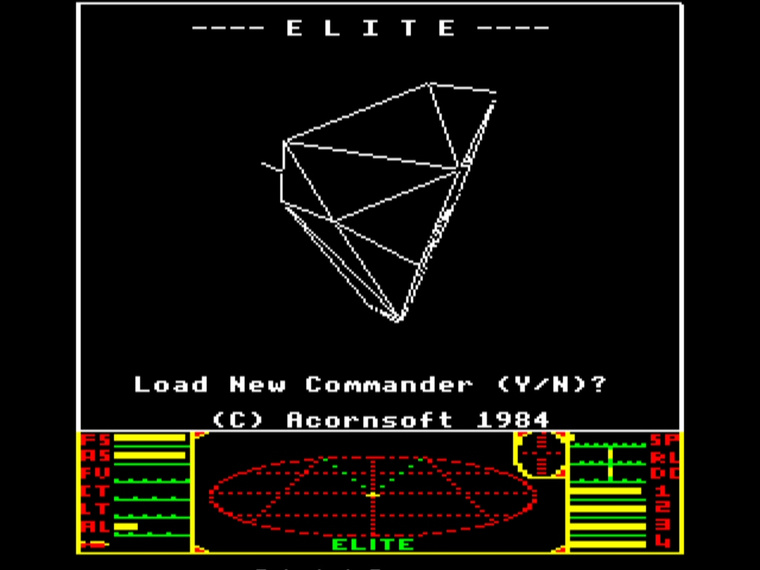
Developers today can only dream of such record sales. Illustrative of the significance of selling one hundred thousand copies of a game in 1984 is the fact that the BBC devoted time to it in its morning news programme. One can imagine the fervour the news created that Elite would be released not only for Acorn and BBC Micro, but would be re-written for other platforms. Eventually, the game was sold in 600 thousand copies in total for 17 platforms. Although Elite had inspired most of the modern space simulators, they could never repeat the success of the predecessor. Perhaps the fourth sequel, now under development at full speed, will do so; seated in the commander’s chair is Braben again, graphics is first-class, and modern computers are capable of modelling entire universes. However, if there is no breakthrough this time, neither contemporaries nor succeeding generations will remember the game.